
Walker County Arrest Records and Charges
Walker County arrest records originate with the arresting agency. The Alabama Uniform Arrest Report identifies the arrest type, date and time, location, agency facts, warrant details, and up to four charges. It also includes felony or misdemeanor flags, state-code or local-ordinance references, and UCR codes. This is the arrest side of the trail. The sheriff's warning is vital: an indication of arrest does not imply guilt, and every accused person is presumed innocent unless proven guilty.
The charge record begins when a complaint, information, or indictment places a formal accusation in court. The prosecutor decides which charges to pursue, and the Walker County Circuit Clerk keeps the district or circuit case once it opens. The clerk's record then tracks changes to each count. Current custody and booking questions belong with the Sheriff and Jail, while the Walker County inmate record channels explain the difference between local jail and state-prison custody. The full Walker County criminal case file carries the plea, motions, disposition, and sentence beyond the charge itself.
The Walker County Sheriff's Office profile and contact page identifies Sheriff Nick Smith and the agency that handles local arrest records. The source image grounds the law-enforcement side of Walker County arrest and charge research.

The sheriff source supports agency contact, but it is not a public mugshot or booking database.
Walker County Charges After Arrest
An officer's arrest allegation and a prosecutor's filed charge are related but distinct. The arrest report records why custody occurred. The prosecutor reviews the facts and decides what accusation should proceed. A misdemeanor may start through a complaint. Felony prosecution can involve a grand-jury indictment. An information is a prosecutor-filed charging document used where the law and procedure permit. The exact document and route depend on the offense and procedural stage, so the court file should control any statement about what was formally filed.
| Document | Source | Role in the Charge Record |
|---|---|---|
| Complaint | Sworn allegation or prosecutor filing | States the alleged offense and can begin a misdemeanor or early criminal proceeding. |
| Information | Prosecutor | Formally states charges in a prosecution when that filing method is legally available. |
| Indictment | Grand jury | Formal charging instrument commonly associated with felony prosecution in Circuit Court. |
Walker County District Court handles district criminal matters, many misdemeanors, and preliminary felony proceedings. Circuit Court handles felony prosecutions and has general criminal jurisdiction. A city ordinance or municipal misdemeanor can begin in municipal court instead. That venue matters because a city case may require contact with the city court before it appears in a later Circuit Court appeal.
Find Walker County Arrest Charge Records
There is no official free Walker County online arrest roster in the inspected sheriff sources. For court charges, use Alacourt Access, Alabama's statewide trial-court portal. It supports paid name and case-number searches at $9.99 each. Its case detail can include case status, court actions, setting dates, parties, financial history, and the case action summary. A no-match result still counts as a search, so verify the name, venue, and case number before paying.
- Start with the arresting agency when booking, arrest time, warrant, or arrest-report facts are needed.
- Open Alacourt and choose a name search, or use the exact case number if the clerk or arrest report provides it.
- Limit the review to Walker County and confirm whether the case is in District Court, Circuit Court, or a municipal venue.
- Read every filed count, statute code, severity, and status. Check later entries for amendments or dismissal.
- Contact the Circuit Clerk when a document image is missing, the file is older, or a certified copy is required.
The local fallback is the Walker County Circuit Clerk at 1803 3rd Avenue, Suite 205, Jasper, AL 35501, phone (205) 384-7268. Office hours are Monday through Friday, 8:00 a.m. to 4:00 p.m., closed noon to 1:00 p.m. Requests can be made in person, by phone, or by mail. For an arrest or booking report that is not posted online, contact the Sheriff's Office at 2001 2nd Avenue, Jasper, AL 35501, non-emergency phone (205) 302-6464, and use the Alabama public-records request process.
Note: AlaFile is an e-filing system for parties and attorneys, not a public arrest-record or court-charge search.
Walker County Arrest Report Fields
The blank Alabama Uniform Arrest Report hosted by the sheriff shows how an arrest record is structured without exposing a real person's information. Its fields include Warrant, Call, On View, No, or Unknown as the arrest type; warrant number and issue date; date, time, and place of arrest; the arresting jurisdiction; and condition descriptions. The form also records whether the person resisted arrest, had injuries, was armed, and had been arrested before.
Charge lines one through four can each carry a felony or misdemeanor flag, UCR code, state statute or local ordinance, and warrant details. One arrest can therefore produce several alleged offenses. In the local court research, a felony is punishable by at least one year and one day in prison, while a misdemeanor may carry up to one year in county jail or a fine. The incident/offense form adds an incident case number, warrant-signed flag, warrant number, and arrest status. These fields are law-enforcement data. They may help locate the later court case, but they do not show the final charge decision or conviction.
- UCR code
- A classification used for uniform crime reporting, not the court's final disposition.
- Warrant number
- An identifier tied to the arrest authority when an arrest is made under a warrant.
- State code or ordinance
- The law cited for an alleged offense, which may be revised when charges are filed.
- Arrest type
- The form category describing whether the arrest followed a warrant, call, or officer observation.
The blank forms are useful as field maps, not as proof of any real arrest. Confirm the completed report with its law-enforcement custodian.
Walker County Court Charge Status
Charge status changes as prosecutors and courts act. “Pending” means no final result is shown yet. An amended count changes the allegation or its details. A reduction replaces a more severe accusation with a less severe one. Dismissal ends that charge without conviction. “Nolle prosequi” means the prosecutor declines to proceed with that count at that time. A case can contain more than one status because each count follows its own course.
| Status | What It Means | What to Check Next |
|---|---|---|
| Pending | The court record has no final result for that count. | Review settings and the newest case action. |
| Amended or reduced | The original accusation changed in wording, code, or severity. | Match the new count to its plea and disposition. |
| Dismissed | The charge ended without a conviction on that count. | Confirm whether other counts remain. |
| Nolle prosequi | The prosecutor recorded that the state would not continue that charge then. | Read the docket for the filed order and context. |
| Guilty or not guilty | The count reached a plea or adjudicated result. | Review sentence or acquittal-related entries. |
Pretrial diversion can also affect the outcome. Walker County's local court source says certain first-time, nonviolent misdemeanor defendants may qualify for the District Attorney's highly supervised restorative program. The District Attorney's Office at (205) 384-7272, 1803 Third Ave, Jasper, AL 35501 controls eligibility and program details. Because official and later reporting differ on the officeholder's name, the office is identified here without labeling either individual as the current district attorney.
Walker County Charges vs Convictions
Being arrested or charged is not the same as being convicted. An arrest report records an enforcement act. A charge is a formal accusation. Conviction requires a guilty plea or guilty finding. A record can show arrest and filed charges even when every count is later dismissed or ends in acquittal. Always read through the final disposition for each charge.
| Point | Charge | Conviction |
|---|---|---|
| Meaning | An accusation filed for court action. | A guilty result entered by plea or adjudication. |
| Timing | Appears at or near the beginning of the case. | Appears after the charge is resolved. |
| Can it change? | May be amended, reduced, dismissed, or declined. | May lead to sentencing, probation, fines, restitution, or appeal. |
| What proves it? | The filed charging document and current docket. | The final disposition, plea, verdict, and judgment entries. |
The distinction matters most with a common name or an incomplete search result. Match date of birth and other lawful identifiers when available, confirm Walker County as the venue, and do not treat a charge line as an outcome.
Served Warrants and Arrest Records
Walker County does not publish an official active-warrant list in the sources inspected. The local warrant page states that an arrest warrant is not a public record until it is served. A person who suspects an outstanding local warrant must appear in person at the Sheriff's Office at 2001 2nd Avenue, Jasper. The non-emergency number is (205) 302-6464. A served warrant may later connect to an arrest report and Alacourt criminal case, but Alacourt is not an active-warrant database.
Jurisdiction changes the route. Felony offenses in Walker County and misdemeanors outside municipal limits use the county warrant-magistrate process. An incident within city limits starts with that city or town police department. A municipal bench warrant should be checked with the issuing municipal court. Walker County traffic failure to pay or appear may also cause an arrest warrant. The Circuit Clerk or magistrate number for warrant appointments after a police report is (205) 384-7268.
The served-warrant boundary also affects public-record requests. The sheriff may provide public arrest, incident, or served-warrant material subject to exemptions, but an unserved warrant is not public under the local rule. That limit should not be bypassed through a court-charge search. When bonding someone out of the Walker County Jail, the jail page calls for a $35 money order payable to the Circuit Clerk. That clerk fee is separate from cash or property required for the bond itself.
Alabama Arrest and Charge Channels
Different statewide systems answer different questions. Alacourt covers trial-court cases and filed charges. The Alabama Department of Corrections inmate search covers current state-prison inmates, not Walker County jail bookings. The Alabama Law Enforcement Agency provides an online-services index with public-record request options and other state tools. Its Community Information Center hosts the sex offender registry, which is a separate statutory registry rather than a general arrest or criminal-history database.
ALEA's online-services index brings together several official state services and record-request routes. The captured source shows the broader statewide channel available when the needed record is held by ALEA rather than the Walker County court.
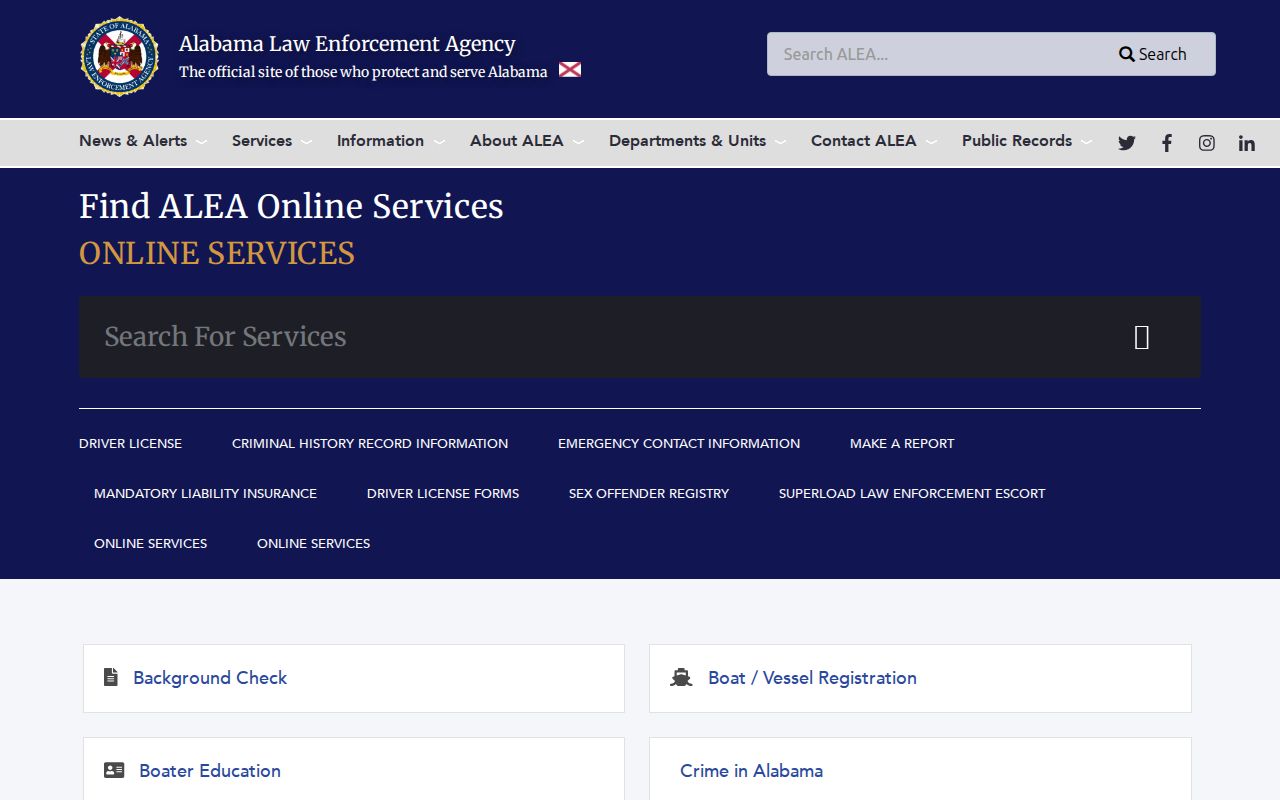
ALEA services supplement local arrest and charge sources; they do not replace the Circuit Clerk's case record.
ALEA's sex offender registry information explains the registry's public scope and exclusions. This source image helps prevent the registry from being mistaken for a complete list of Walker County arrests.
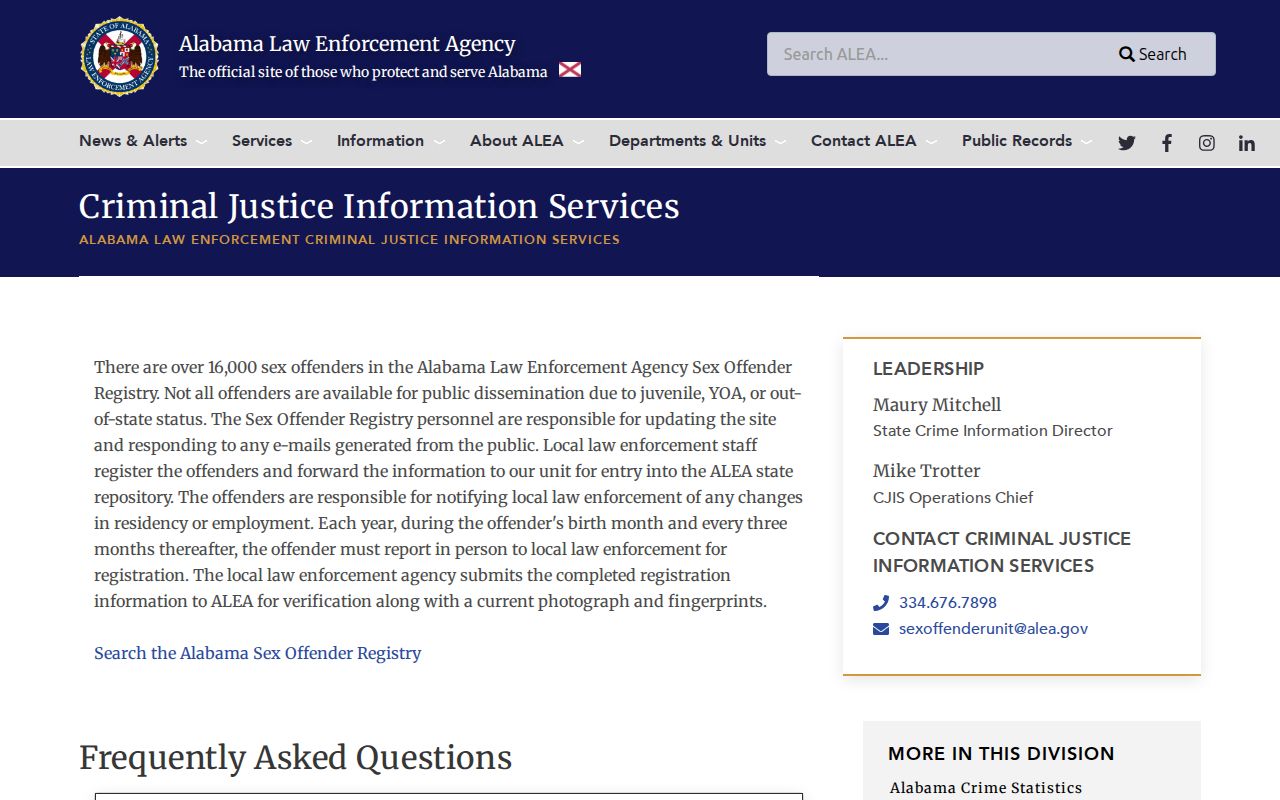
ALEA notes that some offenders may be absent because of juvenile, Youthful Offender Act, or out-of-state status.
The ALEA Community Information Center is the official public registry portal. Its captured screen provides the search channel for that narrow record type.
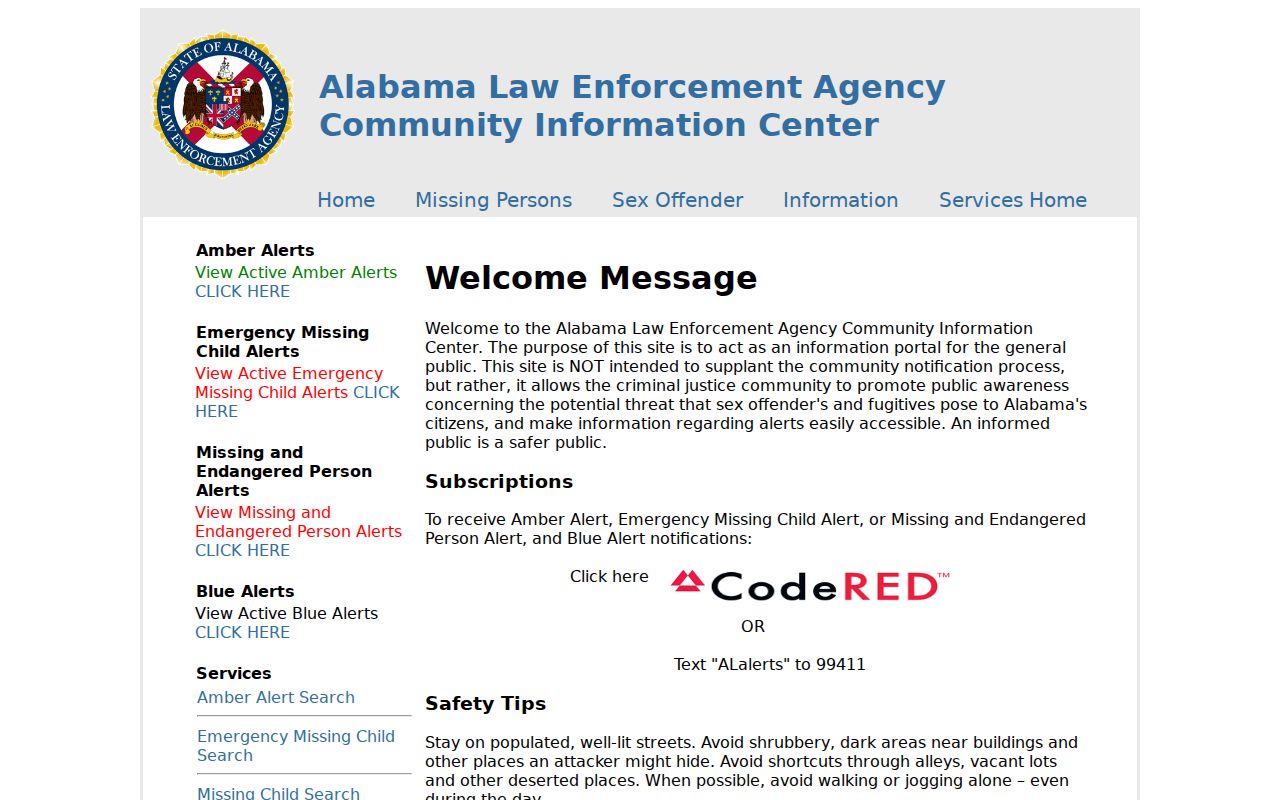
Registry presence or absence should never be used to infer the full arrest, charge, or conviction history of a person.
Note: The Walker County Sheriff's app is documented for news, tips, crime reporting, and outreach, not a confirmed inmate or warrant search.
Walker County Sealed and Expunged Charges
A sealed charge record is hidden from routine public inspection because a law or court order limits access. An expunged record has received relief under Alabama Code Section 15-27-1 and related sections. Expungement restricts ordinary public access to an eligible arrest or charge, but it does not mean every government record is destroyed for every purpose. Courts and law-enforcement agencies may retain controlled access where the law permits.
- Sealed
- Public inspection is blocked while authorized users may retain limited access under the governing rule or order.
- Expunged
- An eligible arrest or charge is restricted from ordinary public view after the court grants statutory relief.
- Juvenile record
- A separately protected category under Alabama law, including juvenile law-enforcement records covered by Section 12-15-134.
- Protected identifiers
- Social Security numbers, account numbers, minor-identifying facts, and other details redacted from public copies.
The petition for expungement is filed in the court that handled the charge, which may be a Walker County district, circuit, or municipal court. A filer should gather the case number, arrest agency, charge, and certified disposition. Prosecutor and victim notice or objection rights can apply. Confidentiality, sealing, and expungement are different legal paths, so the clerk should be asked which rule controls access to a missing record.
Public Walker County Charge Records
Alabama Code Section 36-12-40 supports citizen inspection and copying of public records except where another statute creates an exception. Section 36-12-41 addresses copies and lawful fees, while Sections 36-12-43 through 36-12-46 establish request procedures. In practice, the request starts with the custodian: the Circuit Clerk for filed court charges, the Sheriff's Office for arrest and served-warrant records, and the city agency for a municipal arrest or case.
The Circuit Clerk states that most court records are public but maintains confidentiality for records protected by law. Juvenile records, sealed and expunged charges, personal identifiers, and some active investigative material are not open like an ordinary adult case. A blank online result can also mean the wrong spelling, county, court level, or date. It is not proof that no record exists.
Important: These public-search materials cannot be used for credit, employment, housing, insurance, or another FCRA-regulated decision.
For a reliable result, verify identity with the originating office, distinguish arrest from filed charge, and trace each count to its most recent status. The court's final disposition controls whether a charge led to conviction.