
Walker County District Court Overview
Walker County forms Alabama's entire 14th Judicial Circuit. Within that local system, District Court is the front-line venue for small claims, many traffic citations, district civil cases, district criminal matters, preliminary felony proceedings, and certain misdemeanors. Circuit Court is the general-jurisdiction court for felony prosecutions, larger civil disputes, domestic relations, and appeals from District, Municipal, and Probate Courts.
The Walker County Circuit Clerk keeps records for both court levels. District Court files can include the case number, parties, complaint or charge, settings, rulings, status, financial history, and a detailed case action summary. Public files may be searched online or requested from the clerk. Juvenile, sealed, expunged, and other protected records are not ordinary public files.
The official Walker County judges roster shows the county's district and circuit judicial officers together.
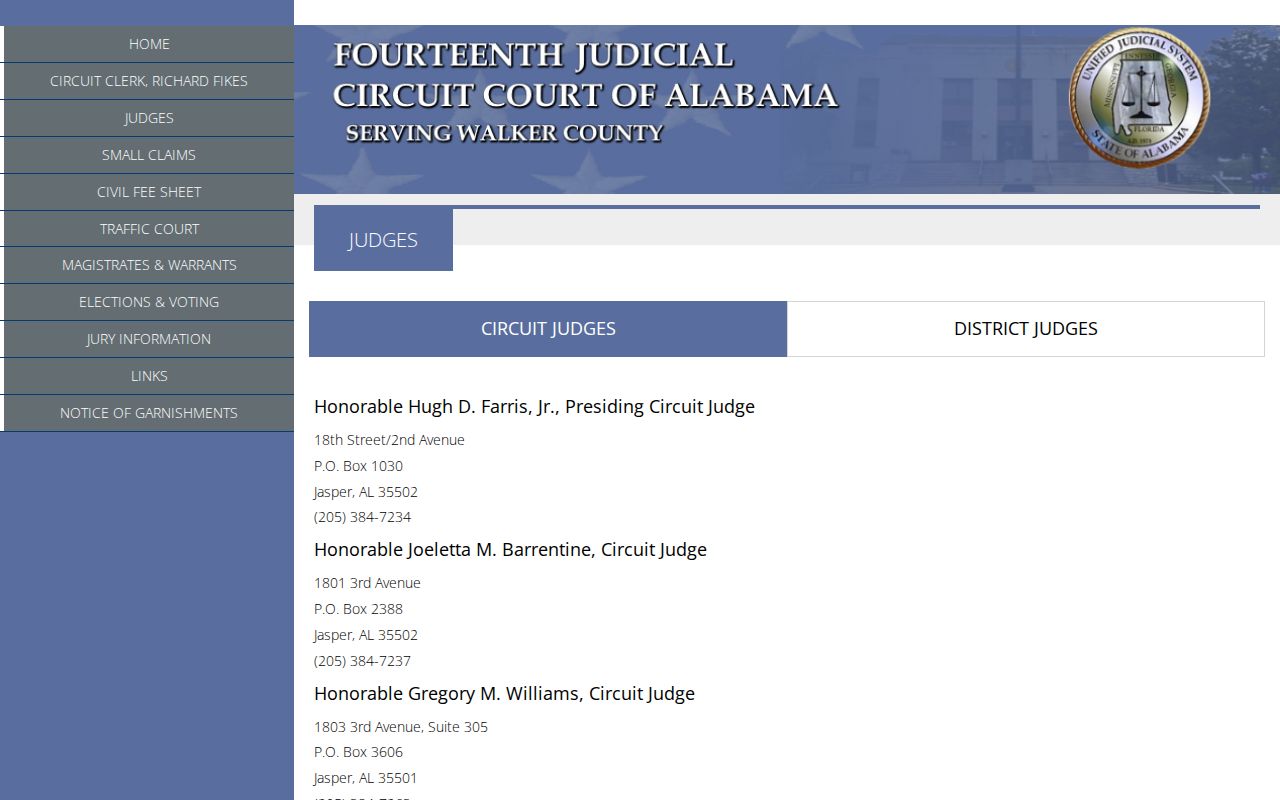
This shared roster reflects one county circuit with distinct limited-jurisdiction and general-jurisdiction trial courts.
Walker County District Court Judges
Hon. Henry P. Allred and Hon. Allison Jones are Walker County's two District Judges. Their courthouse suites and direct office numbers differ. The full local trial-court table is included because a District Court user may need to identify an appeal judge, a Circuit Court case, or the clerk who holds both levels of records.
| Court / Judge | Type | Address | Phone |
|---|---|---|---|
| Hon. Henry P. Allred | District Judge | 1801 3rd Ave., Suite 214, Jasper, AL 35501 | (205) 384-7260 |
| Hon. Allison Jones | District Judge | 1801 3rd Ave., Suite 216, Jasper, AL 35501 | (205) 384-7240 |
| Hon. Hugh D. Farris, Jr. | Presiding Circuit Judge | 18th Street/2nd Avenue; P.O. Box 1030, Jasper, AL 35502 | (205) 384-7234 |
| Hon. Joeletta M. Barrentine | Circuit Judge | 1801 3rd Avenue; P.O. Box 2388, Jasper, AL 35502 | (205) 384-7237 |
| Hon. Gregory M. Williams | Circuit Judge | 1803 3rd Avenue, Suite 305; P.O. Box 3606, Jasper, AL 35501 | (205) 384-7263 |
| Richard E. Fikes | Circuit Clerk | 1803 3rd Avenue, Suite 205, Jasper, AL 35501 | (205) 384-7268 |
The courthouse public location is 1801 Third Avenue South, second floor, while the Circuit Clerk uses the 1803 3rd Avenue suite address. Public hours are Monday through Friday, 8:00 a.m. to 4:00 p.m., with a noon-to-1:00 p.m. closure. Visitors should allow time for downtown parking and the metal detector.
Walker County Court Jurisdiction Compared
Alabama does not use a generic county court or justice-of-the-peace court as Walker County's trial-court structure. The relevant comparison is District Court, Circuit Court, Probate Court, and a municipal court. Filing with the wrong office can delay access because the Circuit Clerk does not hold ordinary probate records, and city citations may remain with the issuing municipal court.
| Point | District Court | Circuit Court | Probate Court | Municipal Court |
|---|---|---|---|---|
| Core role | Limited-jurisdiction trial court | General-jurisdiction trial and appeal court | County probate and related statutory work | City ordinance and municipal case court |
| Typical matters | Small claims, district civil, traffic, misdemeanors, preliminary felony matters | Felonies, larger civil cases, domestic relations, lower-court appeals | Estates, guardianships, conservatorships, adoptions, commitments, name changes | City ordinance, municipal traffic, municipal misdemeanors, bench warrants |
| Record keeper | Circuit Clerk | Circuit Clerk | Probate Office | Issuing city court |
| Appeal path | To Circuit Court where allowed | To the appropriate Alabama appellate court | To Circuit Court in matters described by law | To Circuit Court where allowed |
Small claims is a division of District Court with informal procedures and no jury at that level. Probate Court is in Courthouse Annex II and keeps its own case and recorded-instrument channels. A municipal bench warrant or ticket should be checked with the city that issued it.
Walker County District Court Case Flow
A case starts with the event and filing that fit its type. A small claims plaintiff files a complaint and arranges service. A district criminal matter may begin with a complaint, arrest, or warrant. Traffic cases begin with a citation. Each path then creates a case number, settings, actions, costs, and an outcome in the clerk's record.
Small claims flow: Complaint Filed › Service › Answer Due › Trial Setting › Judgment › Collection or Appeal
District criminal flow: Complaint or Arrest › First Appearance › Plea and Pretrial Action › Trial or Disposition › Sentence › Appeal
Traffic flow: Citation › Payable Resolution or Court Appearance › Plea › Disposition › Fine, Cost, or Other Order
Preliminary felony matters can begin in District Court and continue in Circuit Court. An appeal is not a simple transfer request. The party must meet the filing deadline, pay the required fee or obtain approved relief, and ensure the clerk has what the appellate record requires.
Walker County District Court Cases
District civil records cover limited-jurisdiction civil disputes, motions, judgments, and collection actions. Small claims is the more informal District Court division. District criminal files may show complaints, warrants, charges, pleas, settings, dispositions, sentences, fines, restitution, and bonds. Traffic files can show the citation, offense, court date, plea, disposition, costs, failure-to-appear action, and any driving-school order.
- District civil
- A civil trial file outside the small claims division, with pleadings, service, rulings, and judgment entries.
- Small claims
- An informal, no-jury District Court action for a money dispute within the local limit.
- District criminal
- Misdemeanors, preliminary felony work, and other criminal matters within limited jurisdiction.
- Traffic
- State or county citations assigned for appearance before Walker County District Court.
Domestic relations and larger civil matters are associated with Circuit Court. The unified Walker County Circuit Clerk keeps both district and circuit files, which is why one office can direct a requester to the right court level.
Walker County District Court Small Claims
The Walker County small claims division handles claims up to $6,000. Its process is designed to be simple, informal, and less costly than a broader civil suit. There is no jury in small claims court. The court assigns a case number after the complaint is processed, and that number should be used in later contact.
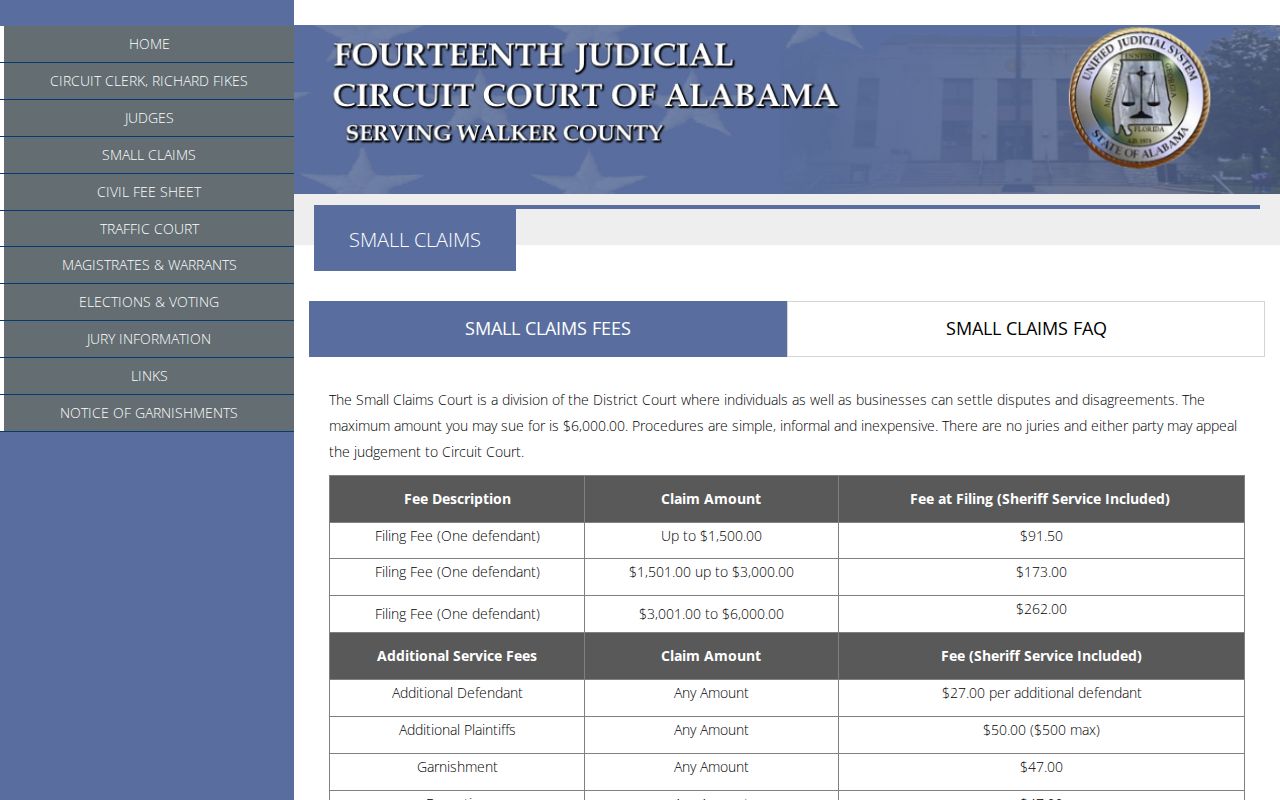
The local instructions supply deadlines and post-judgment facts that matter when reading the court record.
- File the complaint with the correct party names and service information. Fees depend on the claim amount and service method.
- After service, the defendant has 14 calendar days to file an answer.
- If an answer is filed, the trial is set about six to eight weeks after the court receives it.
- After judgment, either party may appeal to Circuit Court within 14 calendar days.
- A winning plaintiff must pursue collection. The court does not collect the judgment.
The local page says a judgment can remain valid for up to ten years. Collection tools may include garnishment, bank garnishment, execution or levy, and a certificate of judgment. Appeal fees are listed as $281 for a non-jury trial or $381 for a jury trial in Circuit Court.
Walker County District Court Civil Fees
Filing cost changes with the division, claim tier, number of defendants, and service method. Sheriff service generally costs more than certified mail. The published sheet also includes added charges for subpoenas, garnishments, executions, and other later work.
| District Court filing | Sheriff service | Certified mail |
|---|---|---|
| Small claims up to $1,500, one defendant | $91.50 | $79.50 |
| Small claims $1,501-$3,000, one defendant | $173 | $161 |
| District civil, one defendant | $294 | $281 |
| Additional small claims/district civil defendant | $27 | $5 |
| Civil subpoena | $29 | $17 by certified mail/process server |
| Execution | $47 | $35 by certified mail/process server |
The official Walker County civil fee sheet is the source to check before filing because the researched small claims fee table stops at the $1,501-to-$3,000 tier even though the jurisdictional maximum is $6,000.
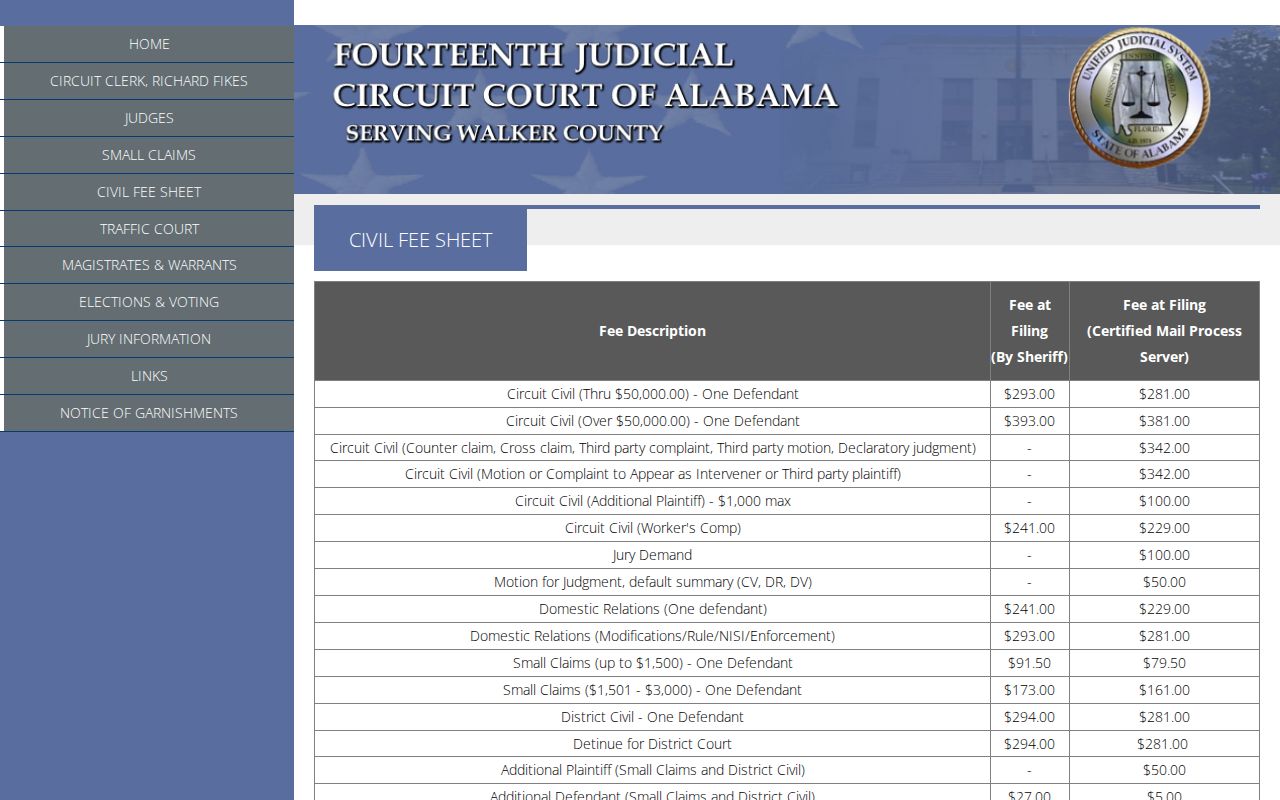
The fee image helps a filer compare the type of action with service and post-judgment costs instead of treating one quoted amount as a complete total.
Walker County District Court Traffic Cases
State and county traffic citations on the local court page are issued for appearance before Walker County District Court. A payable ticket may be handled by credit or debit card through Alapay or by phone at (877) 252-7294. The Alabama Traffic Service Center also answers questions at (866) 954-9399. Mail payment requires the signed guilty plea on the ticket copy and a money order or cashier's check sent to the Circuit Clerk. Personal checks are returned.
A driver who wants to contest a ticket or request driving school should act before the court date. Driving school is allowed only at the judge's discretion. The person must appear or write to the judge before that date. Failure to pay or otherwise resolve the case and failure to appear can lead to an arrest warrant, ALEA license suspension, an increased fine, and forfeiture of any bond.
District criminal records are broader than traffic payment records. They can contain the complaint or warrant, charges, plea, settings, disposition, sentence, costs, restitution, bond, and case action summary. An unserved warrant is not public in Walker County, although a served warrant may later appear as part of the public criminal case.
Search Walker County District Court Records
Alacourt Access is the statewide trial-court search channel. It supports a name search when the case number is unknown and a case-number search when the exact identifier is available. Each search costs $9.99. A detail report can include case basics, status, setting dates, parties, court actions, financial history, and the case action summary.
Document images cost $5 for the first 20 pages and $0.50 for each later page when an image is available. District case monitoring is listed at $19.99. Online access does not mean every filing is public or imaged. For older material, certified copies, missing images, or a setting that is unclear, call Richard E. Fikes' Circuit Clerk office at (205) 384-7268, visit Suite 205, or mail a specific request to that address.
The Walker County docket entry is another online route. AlaFile serves as an e-filing system for supported filers and cases, not as a free public research database. Municipal records stay with the issuing city court, while probate case and land-record requests use the Probate Office and its own portal.
Note: Most District Court records are public, but protected law controls access to juvenile, sealed, expunged, and confidential material.
Walker County District Court Appeals
Circuit Court reviews appeals from Walker County District Court. In a small claims case, either side has 14 calendar days after judgment to appeal. The local page lists separate Circuit Court fees for a non-jury or jury appeal. Other District Court matters may have different deadlines and procedures, so the small claims period should not be applied to a traffic or criminal case without checking the governing rule.
Richard E. Fikes and the Circuit Clerk staff prepare appeal records as part of the office's court-management role. The record may contain the pleadings, orders, settings, case action summary, allowed exhibits, financial entries, and notice of appeal. The higher court reviews the matter through the process allowed for that case type. Alabama's Court of Civil Appeals, Court of Criminal Appeals, and Supreme Court sit above Circuit Court in the state hierarchy.