
Walker County Active Warrant Access
Walker County does not publish an official public active-warrant database in the official sources reviewed. The local court instructions give a stricter rule: an arrest warrant is not a public record until it has been served. A person who thinks a warrant may have been issued against them must appear in person at the Walker County Sheriff’s Office. The office is at 2001 2nd Avenue, Jasper, AL 35501. The non-emergency number is (205) 302-6464. Office hours are Monday through Friday from 8:00 a.m. to 4:00 p.m. Calling first can help with current entry and security procedures, but the official warrant instruction still directs the suspected subject to appear.
A general case search is not a substitute for that process. Alacourt Access may show a criminal case, a served warrant tied to the case, a failure-to-appear action, settings, or court financial data. It is a paid trial-court case system, not a live Walker County warrant list. A public-records request may reach a served warrant, incident report, or arrest record, subject to lawful limits. It cannot turn an unserved warrant into a public record. That distinction is central to an accurate search.
Important: No official source confirms a public Walker County active-warrant search, and an unserved arrest warrant is not open for public inspection.
Verify a Walker County Warrant
The correct Walker County warrant check depends on who issued the order. County felony matters and offenses outside city limits begin with the sheriff and Walker County warrant magistrate channel. A warrant linked to a state or county traffic citation belongs with District Court and the Circuit Clerk. A municipal citation or incident inside a city or town may produce a municipal bench warrant, so the issuing city’s police department or court must be contacted. Use the following order to avoid relying on the wrong agency.
- Identify whether the event involved a county deputy, state trooper, municipal officer, or an existing court case. Keep any citation or case number at hand.
- For suspected local arrest warrants, call or appear at the Walker County Sheriff’s Office. Follow staff directions for an in-person status check.
- For traffic failure to appear, call the Circuit Clerk at (205) 384-7268 or use the official traffic service channels to ask about the case and court date.
- For a city case, contact that municipality’s police department or municipal court. Walker County offices may not control a city warrant.
- Ask whether bond has been set and what release payment is required. Consult counsel before making statements, then confirm that the court and jail systems reflect the resolution.
Clearance may not appear in every system at the same moment. Keep receipts, court orders, and the name of the office that handled the matter. A resolved case can still look open if data entry has not reached another agency. For broader context on the filed case, Walker County criminal court records may show later actions after the warrant is served.
Walker County Warrant Check Details
There is no official Walker County web form with public last-name, first-name, or birth-date fields for active warrants. The practical verification fields come from the sheriff, clerk, citation, and court channels. Provide only what the official office requests. A case number or citation can help staff separate people with similar names, while the issuing agency and incident location determine which office owns the matter.
| Detail | Format | When Needed | Use |
|---|---|---|---|
| Full legal name | Text | Usually | Helps the sheriff or clerk identify the subject. |
| Date of birth | Date | If requested | Helps distinguish people with the same or similar names. |
| Case or warrant number | Number | If known | Connects the inquiry to an existing court or served warrant record. |
| Citation number | Text | Traffic cases | Links a failure-to-appear question to the District Court citation. |
| Issuing agency and location | Text | When known | Separates county matters from municipal police or court matters. |
These are Walker County contact and record-matching details, not fields in a public active-warrant portal. Do not send sensitive identifiers through a sheriff app tip, social media message, or unofficial website.
Walker County Warrant Types
Warrant labels describe different court powers and different routes to information. An arrest warrant authorizes an arrest after a finding of probable cause. A bench warrant generally follows a failure to obey a court order, such as missing a setting. A search warrant permits a defined search for evidence. A capias is a court order used to bring a person before the court and may arise after failure to appear. The local warrant process also divides matters by the site and class of the alleged offense.
- County misdemeanor: the Walker County magistrate channel covers an offense outside municipal city limits.
- County felony: a felony occurring in Walker County requires investigation by the law-enforcement agency with jurisdiction.
- Traffic warrant: a missed state or county citation in District Court may lead to a failure-to-appear arrest warrant.
- Municipal bench warrant: a city or town court handles warrants tied to its own cases and citations.
- Worthless-check warrant: the local magistrate channel covers a check received in Walker County.
The issuing court controls each Walker County warrant. A District Court traffic warrant should not be confused with a municipal bench warrant, even when both involve conduct within Walker County.
Note: A search warrant may remain restricted while an investigation is active and is not the same as a public arrest-warrant list.
Walker County Warrant Record Fields
Official Alabama incident and arrest forms show what a served Walker County warrant record may contain. The exact public copy depends on the file, the stage of the case, and redaction rules. A warrant number alone does not show the final result. The related court case may later add a plea, disposition, sentence, financial history, or case-action summary.
| Field | What It Shows |
|---|---|
| Warrant number and issue date | The identifier assigned to the warrant and when it was issued. |
| Warrant-signed flag | Whether the incident form reflects that a warrant was signed. |
| Case number | The court or agency number used to connect related records. |
| Offense and legal code | The alleged offense, state code or local ordinance, and UCR classification. |
| Charge level | Whether the listed charge is treated as a felony or misdemeanor. |
| Arrest details | Arrest type, date, time, agency, and location when an arrest occurs. |
| Deposition facts | The sworn facts considered for a probable-cause decision. |
A charge is an accusation. It is not proof of guilt. Check the full case disposition before drawing a conclusion from a warrant or arrest field.
Requesting Walker County Warrants
The Walker County magistrates and warrants instructions explain how a victim asks for a warrant. A police report must first be made for felony and misdemeanor offenses. Felonies require investigation by the law-enforcement agency that has jurisdiction. The victim then completes a deposition and testifies under oath about the facts. A judicial officer decides whether probable cause exists. If it does, an arrest warrant is issued. There is no cost for this process.
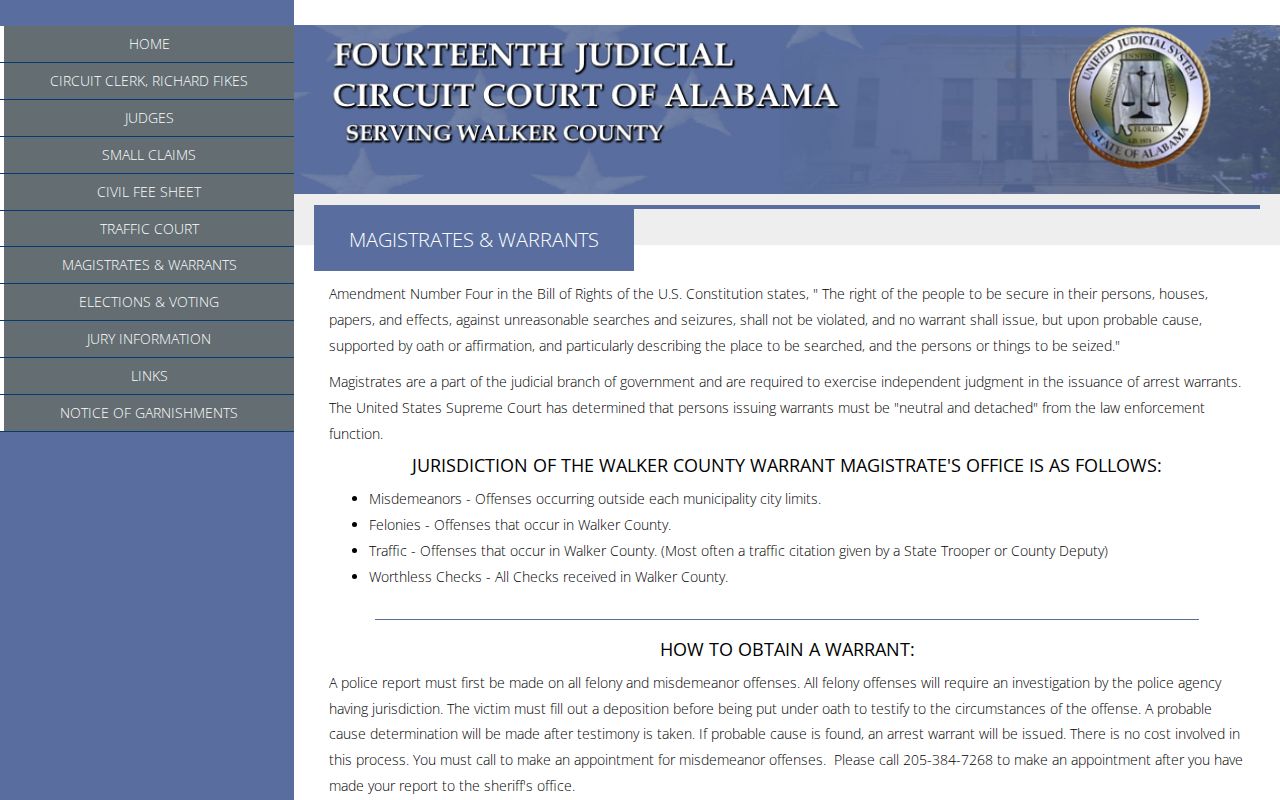
The official page places the police report, sworn deposition, and probable-cause review in sequence, which helps distinguish a warrant request from a public warrant search.
For a misdemeanor, call the Circuit Clerk at (205) 384-7268 for an appointment after the report is made. If the incident occurred inside city or town limits, report it to that municipality’s police department. If it happened outside city limits but within Walker County, use the Sheriff’s Office. Magistrates and court staff cannot help a person fill out the deposition form. They must remain neutral while the facts are presented.
Resolve a Walker County Warrant
Do not ignore a suspected warrant or rely on a third-party name match. Contact the office tied to the case. Ask whether the warrant is active, whether a court date is set, and whether bond terms appear in the official record. The Walker County jail page says a person bonding out an inmate must bring a $35 money order payable to the Circuit Clerk. That clerk payment is separate from any cash or property required for the bond itself. Confirm the current release instructions before arriving.
A lawyer can check the correct court, explain surrender options, and advise against statements that may affect a pending charge. For a traffic failure to appear, the local traffic court instructions warn of more than arrest: license suspension by ALEA, a higher fine, and bond forfeiture may also follow. A municipal matter must be resolved with that municipal court. After the judge, clerk, or jail acts, ask how to verify that the warrant status changed in each relevant system.
Important: Speak with counsel before surrender or admissions, and confirm bond and payment instructions directly with the issuing court or Walker County jail.
Restricted Walker County Warrants
Unserved arrest warrants are not public under the local instruction. Other limits can apply to juvenile matters, sealed cases, expunged records, protected personal data, and active investigations. Alabama Code Section 12-15-134 protects juvenile law-enforcement records from unauthorized disclosure. Alabama’s expungement chapter, Section 15-27-1 and following, can restrict public access to eligible criminal records after a court grants relief. A public copy may also omit personal identifiers.
The Walker County Sheriff’s Office app is an official news, tips, crime-reporting, and public-safety channel. Its official store descriptions do not confirm an inmate roster or warrant lookup, so it should not be used as proof that a warrant exists or has cleared. No official local Crime Stoppers warrant list or reward program was documented in the research. Emergencies belong with 911. A routine tip or app report is not a substitute for the in-person warrant process.
Note: Served records may become available, but the public case file can still omit protected facts or remain restricted by a court order.