
Walker County Criminal Court Records
A criminal court record begins when an accusation becomes a court case. The Walker County Circuit Clerk is custodian for both district criminal and circuit criminal files. Those files may contain a complaint, warrant, formal charges, bond entries, pleas, motions, settings, rulings, disposition, sentence, fines, restitution, and a case action summary. The clerk also manages the financial trail for court costs and criminal payments. That makes the case file broader than a police arrest report and more useful when the goal is to learn what happened after the arrest.
Walker County is Alabama's entire 14th Judicial Circuit. Circuit Court has general criminal jurisdiction and handles felony prosecutions. District Court handles district criminal matters, many misdemeanors, and early felony proceedings. Municipal courts keep city ordinance and municipal misdemeanor cases. A municipal case will not always sit in the Walker County state-court file at its first stage. Appeals from municipal and district courts can move to Circuit Court. Criminal appeals then move through Alabama's appellate system, including the Court of Criminal Appeals.
For a closer view of accusations filed after an arrest, compare the Walker County arrest records and court charges. The criminal case file remains the source for the later plea, ruling, disposition, and sentence.
Search Walker County Criminal Records
Alacourt Access is the statewide online route for Alabama trial-court criminal records. It offers name and case-number searches. Each on-demand search costs $9.99, and a no-match result still counts as a search. Check spelling, county, and known case details first. The portal says its case detail report includes basic case information, status, settings, parties, court action, financial history, and a detailed case action summary. Images cost $5 for the first 20 pages and $0.50 for each page after that when an image is available.
- Open Alacourt and choose a name or case-number search. Use the exact case number when one is known.
- Confirm Walker County before paying. A statewide name search can return cases from other Alabama courts.
- Open the case detail and review each charge, status, setting date, action, and financial entry.
- Read the case action summary in date order. It shows how the file moved from filing through disposition.
- Ask the Circuit Clerk for a copy or certified record when an online image is missing or formal proof is needed.
Online access is only one channel. The Circuit Clerk accepts questions in person at 1803 3rd Avenue, Suite 205, Jasper, AL 35501, by phone at (205) 384-7268, or by mail to that address. Office hours are Monday through Friday, 8:00 a.m. to 4:00 p.m., with a noon to 1:00 p.m. closure. The Walker County docket entry can help locate settings. Older, non-imaged, or protected material may still require clerk contact. AlaFile is for filing documents, not public research.
The Alabama District Attorneys Association directory provides the Circuit 14 prosecutor office contact. This source image shows the statewide directory used to identify the office connected with Walker County criminal prosecutions.
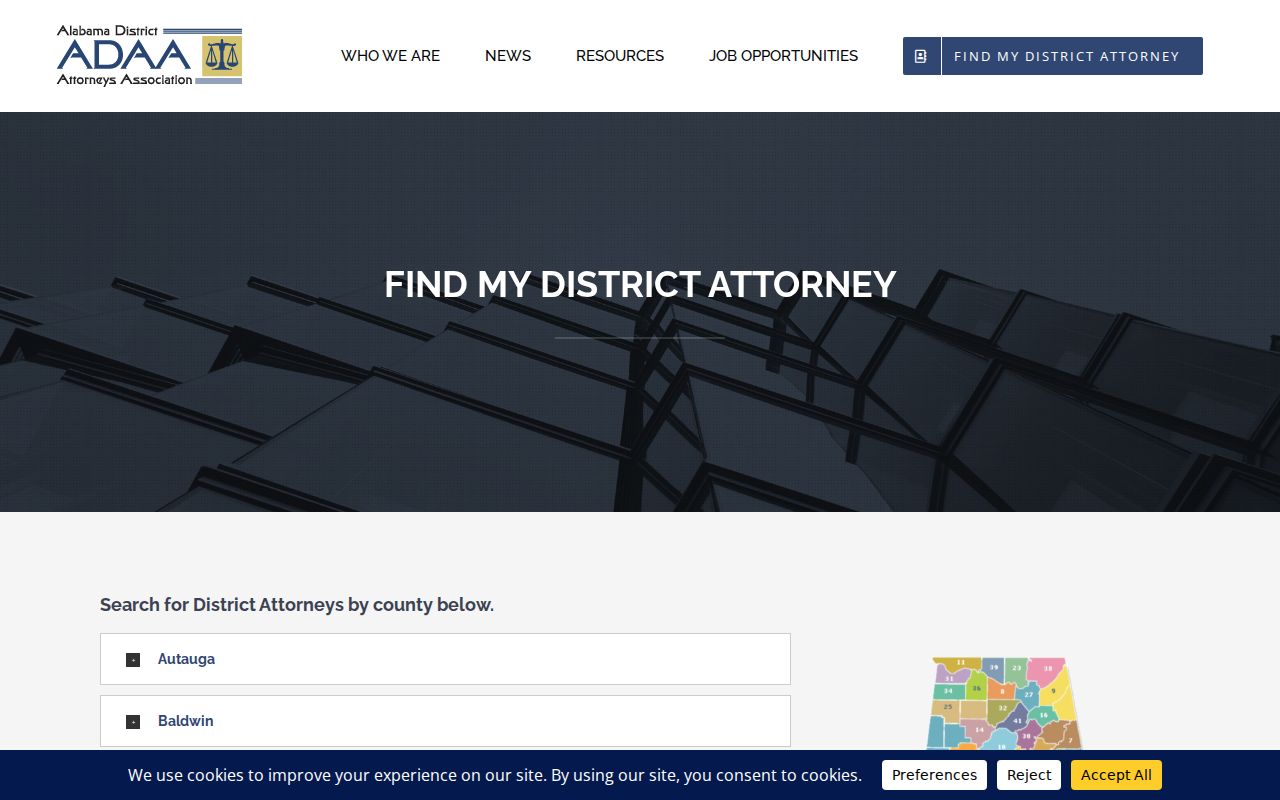
The directory is an office locator, not a substitute for the court case record or its disposition.
Note: Federal charges use a separate court system and will not appear as Walker County state criminal cases.
Walker County Criminal Case Flow
Each stage leaves a different mark in the court record. The first filed charge is not the whole story. A later order may amend the count, resolve a motion, set bond, record a plea, or close the case. Reading entries in order is the safest way to trace the outcome.
Case flow: Charges Filed › Arraignment › Pretrial / Motions › Plea or Trial › Disposition › Sentencing
| Stage | What the Walker County Record May Show |
|---|---|
| Charges filed | The complaint, indictment, warrant reference, statutes, and separate counts that open the court case. |
| Arraignment | The formal handling of charges and the defendant's plea, such as guilty or not guilty. |
| Pretrial and motions | Hearing settings, continuances, bond issues, evidence requests, written motions, and rulings. |
| Plea or trial | A negotiated plea, trial events, verdict, acquittal, or other action resolving each count. |
| Disposition | The current or final result, which may be guilty, not guilty, dismissed, or another recorded outcome. |
| Sentencing | Jail or prison terms, probation, fines, court costs, restitution, and other conditions imposed. |
Walker County also has a local pretrial diversion route for certain first-time, nonviolent misdemeanor defendants. Eligibility and supervision are controlled by the District Attorney's Office, not by a public-record search. Successful diversion can change how the case is resolved, so check the final disposition rather than assuming the filed charge became a conviction. The office contact given by the local court source is (205) 384-7272 at 1803 Third Ave, Jasper, AL 35501.
What Walker County Case Files Show
Alacourt describes report categories rather than publishing a free sample Walker County file. The Circuit Clerk's duties and local research identify the fields that matter most. One case can contain several charges, and each count can end differently. Match the charge entry to its own disposition before drawing a conclusion.
| Field | What It Shows |
|---|---|
| Case number | The court-assigned identifier used for searches, calls, requests, and later filings. |
| Court and judge | Whether District or Circuit Court holds the case and the assigned judicial officer when listed. |
| Defendant and parties | The accused person and the State of Alabama, with public party detail where available. |
| Charges | Each accusation, count, statute or ordinance code, and felony or misdemeanor level. |
| Plea | The response to a count, commonly guilty or not guilty, and later plea changes. |
| Actions and settings | Hearings, motions, court rulings, continuances, and scheduled dates in the case action summary. |
| Disposition | The result for a case or count, including dismissal, acquittal, plea, or guilty finding. |
| Sentence and financials | Custody, probation, fines, restitution, court costs, and posted financial history. |
The Alabama Office of Indigent Defense Services explains the state system that supports appointed counsel for defendants who qualify. Its public information is shown in this Walker County criminal-record context because counsel status and court appointments may appear during a case.
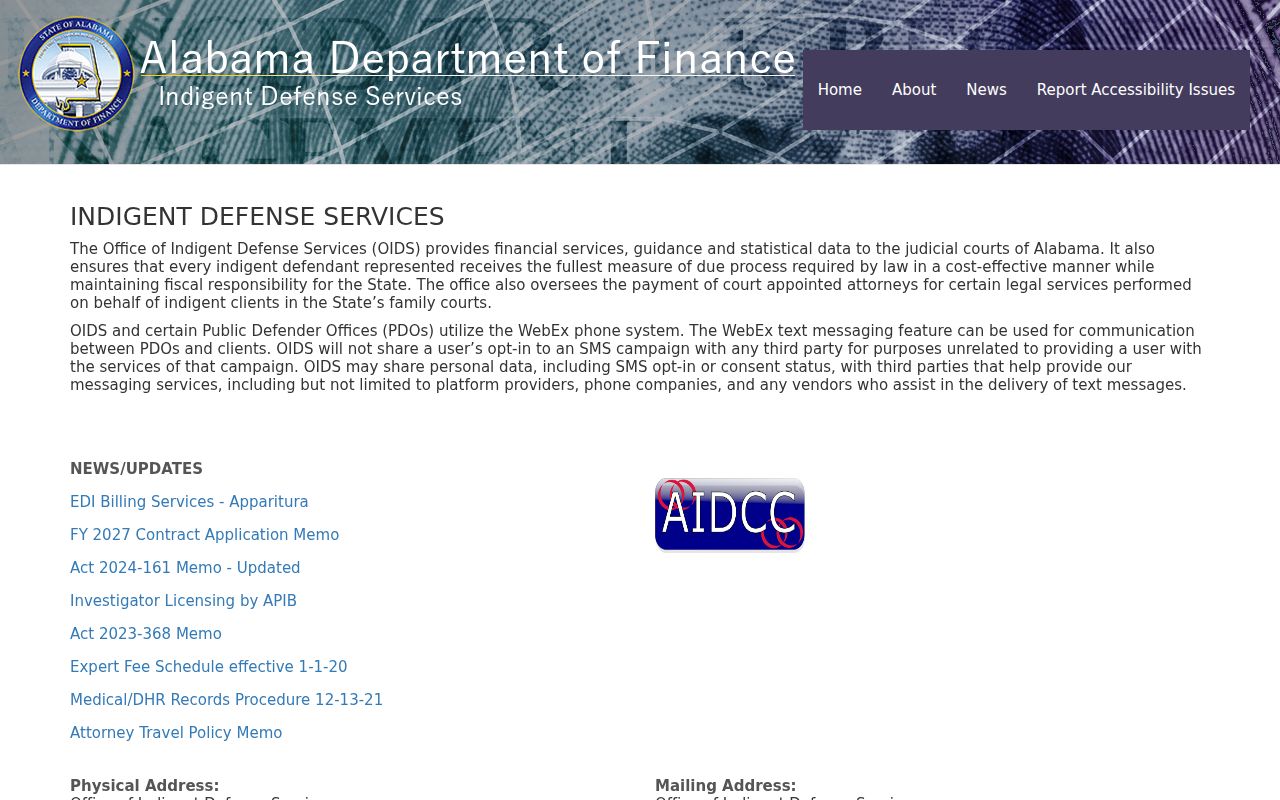
State indigent-defense services are distinct from the federal defender and do not provide the clerk's case file.
Walker County Charges vs Convictions
A charge is an accusation. A conviction is the result of a guilty plea or a guilty finding. Walker County criminal records can show counts that were amended, dismissed, or resolved by acquittal alongside a count that produced a conviction. An arrest or filed complaint therefore cannot prove guilt. Read the plea and final disposition for each count, then check sentencing entries only for a count that resulted in conviction.
| Point | Charge | Conviction |
|---|---|---|
| Meaning | A formal accusation that a law was violated. | A guilty result entered through plea or adjudication. |
| Place in file | Appears near the start and may later change. | Appears in the disposition and supports sentencing. |
| Possible next event | May be amended, dismissed, tried, or resolved by plea. | May lead to sentence, probation, fines, restitution, or appeal. |
The Sheriff's Office also warns that an indication of arrest does not imply guilt. That principle should guide any review of a Walker County criminal case.
Read Walker County Case Outcomes
A disposition states the current or final result. “Guilty” may reflect a plea or trial result. “Not guilty” means the fact finder did not convict on that count. “Dismissed” means the court ended that charge without a conviction. A continuance or pending status is not a final outcome. The record may also reflect diversion, probation, an appeal, or later action. Alabama research defines a felony as an offense punishable by at least one year and one day in prison. A misdemeanor may be punished by up to one year in county jail or a fine.
Sentence entries must be read with the disposition. They can list custody, probation, fines, costs, restitution to a victim, or other terms. Financial history may show amounts assessed and paid, but it does not replace the sentencing order. If a code or short entry is unclear, request the order from the Circuit Clerk. A certified copy is the sound choice when the record must be filed with another court or agency.
Note: A pending setting, bond entry, or payment line does not by itself establish the final result of a criminal charge.
Walker County Sealed and Expunged Files
Restricted files do not follow one simple rule. A sealed record is hidden from ordinary public inspection by law or court order. Expungement is a statutory process that restricts public access to eligible arrest and charge records under Alabama Code Section 15-27-1 and the sections that follow. It does not mean every government copy is physically destroyed or unavailable for every permitted purpose. A person seeking relief must identify the arrest, court, case number, disposition, and agency, then file in the district, circuit, or municipal court that handled the charge.
| Point | Sealed | Expunged |
|---|---|---|
| Basis | A confidentiality law or a court order limits inspection. | Alabama's expungement chapter governs eligible criminal records. |
| Public view | Hidden from ordinary public access while the seal applies. | Restricted from ordinary public inspection after relief is granted. |
| Government access | May remain available to authorized people or agencies. | Controlled access may remain for purposes allowed by law. |
| Next step | Ask the court about the legal basis and authorized access. | Confirm eligibility and file in the court that handled the charge. |
Juvenile law-enforcement records have separate protection under Alabama Code Section 12-15-134. Adoption and mental-health commitment files also are not ordinary public case records. Public copies should omit protected identifiers such as Social Security and financial account numbers.
Public Walker County Criminal Records
Alabama Code Section 36-12-40 gives Alabama citizens a right to inspect and copy public records unless another law provides an exception. Section 36-12-41 addresses copies and lawful fees. Sections 36-12-43 through 36-12-46 add public-request definitions and procedures. The practical local rule comes from the Circuit Clerk: most court records are public, while the office maintains confidentiality for records protected by law.
Key Alabama laws:
Alabama Code Sections 36-12-40 and 36-12-41 support inspection and copying of public records, subject to statutory limits and lawful fees.
Alabama Code Section 15-27-1 et seq. sets the state process for expungement of eligible criminal records.
The public-access law does not turn an unserved arrest warrant into an open record. Walker County's warrant source says an arrest warrant is not public until served. Ongoing investigations and protected law-enforcement material may also remain outside the public court file. Ask the record custodian to identify the office and access rule when a request is denied.
The Alabama Department of Corrections contact and public-records page is a separate source for state-custody material. The captured page helps distinguish corrections records from Walker County court records.
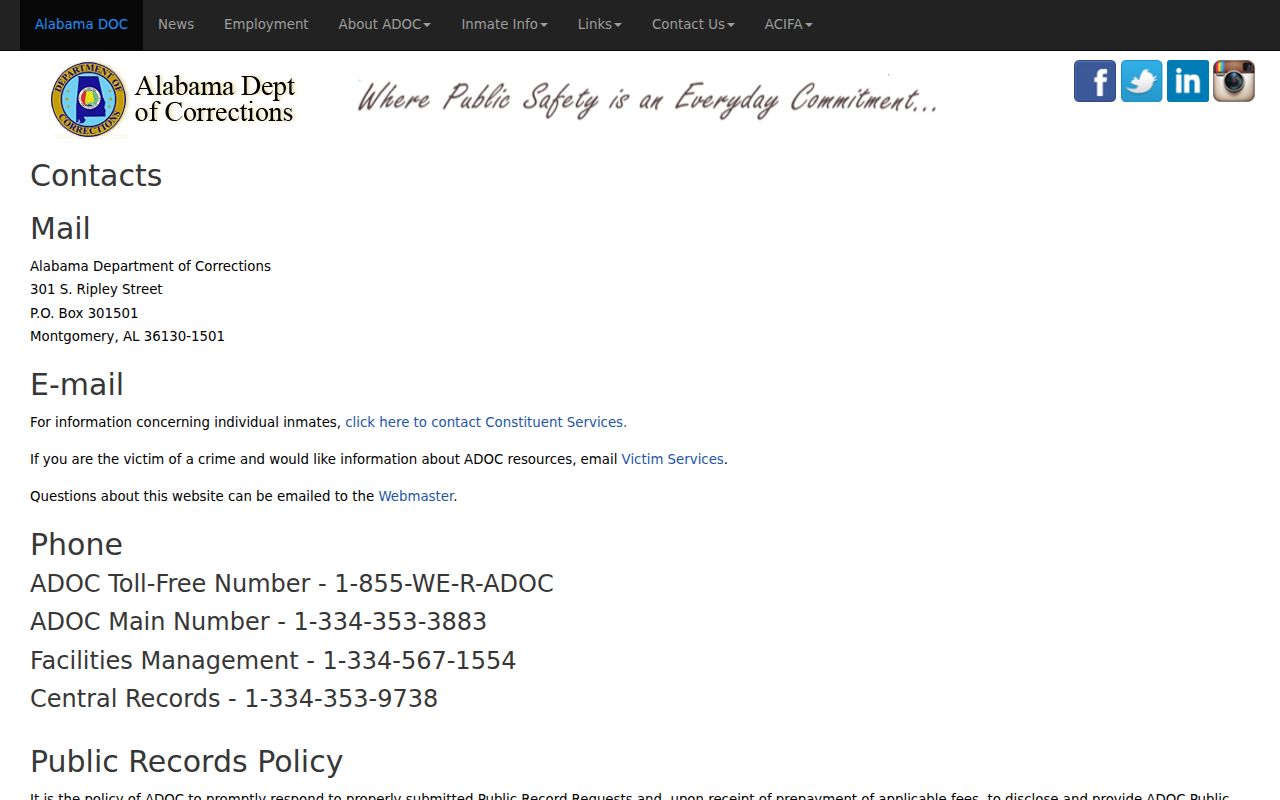
ADOC records may address state confinement, but the Walker County Circuit Clerk remains the source for the local case file.
Federal Criminal Records Are Separate
Walker County lies in the U.S. District Court for the Northern District of Alabama. The Circuit Clerk does not keep federal criminal dockets. Official federal docket sheets and documents are accessed through PACER. The federal U.S. Attorney prosecutes violations of federal law, while the Walker County district attorney prosecutes state cases in Circuit 14. A state search should not be treated as a federal-record search.
The U.S. Attorney's Office for the Northern District of Alabama describes its federal prosecution role. This source image marks the correct federal office for Walker County-area federal charges.
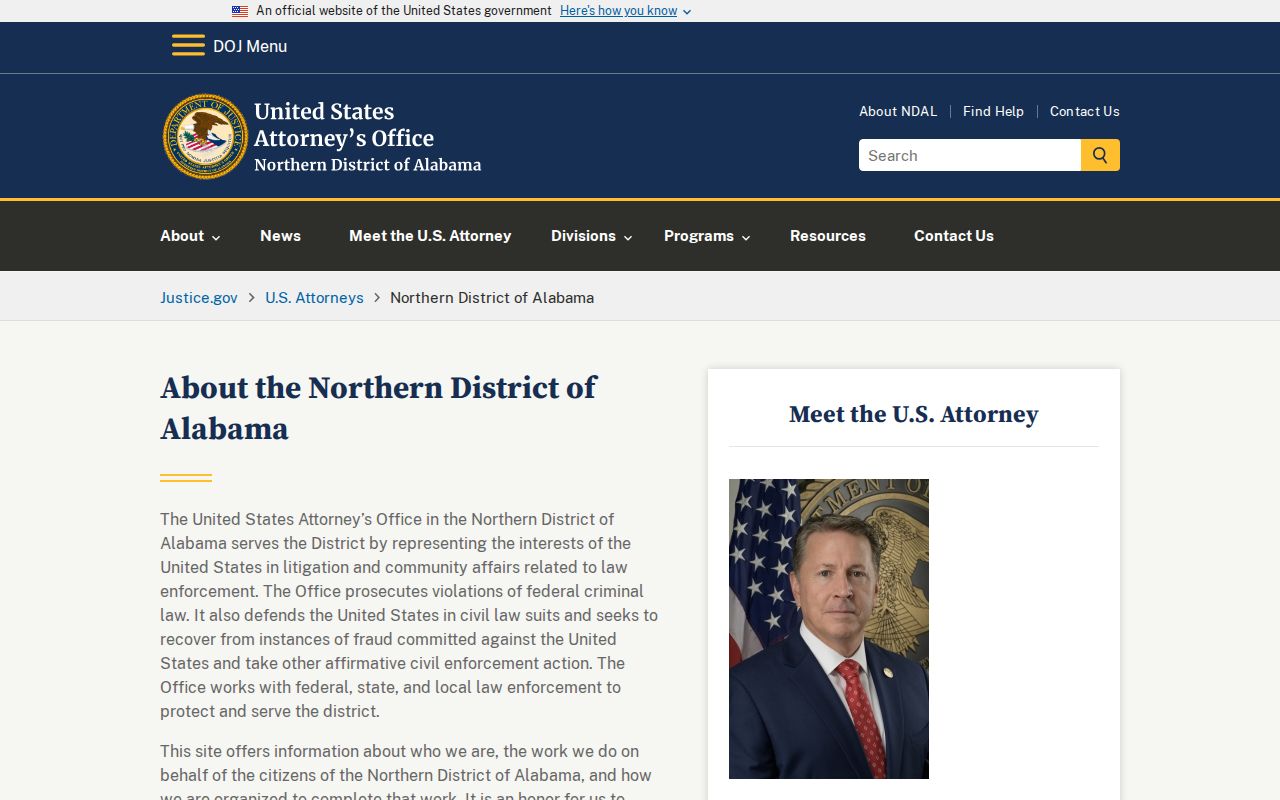
The federal prosecutor page is not a docket search. Use PACER or the federal clerk for an official federal case record.
Birmingham's federal clerk office is at the Hugo L. Black United States Courthouse, 1729 5th Avenue North, Birmingham, AL 35203, phone (205) 278-1700. The Northern District also lists a Tuscaloosa courthouse but notes that location has no clerk's office to accept filings. The Federal Public Defender at (205) 208-7170 serves federal matters, while Alabama's state indigent-defense system applies to qualifying Walker County state defendants.
Restricted Walker County Criminal Records
Juvenile cases, sealed matters, expunged charges, protected identifiers, and some active investigative information will not be open like an ordinary adult case file. A missing online record can also have a routine cause, such as a spelling error, the wrong county, a municipal filing, or an image that was never added to the portal. It should not be treated as proof that no case exists.
For an employment, housing, credit, insurance, or tenant decision, a casual court lookup is not a replacement for a consumer report prepared under the Fair Credit Reporting Act. Verify identity, match the correct person, read every count through disposition, and obtain the needed official record from its custodian.
Important: These public-search materials are not a consumer report and cannot be used for any FCRA-regulated eligibility decision.